Both tools hit hard, but only one drills. Here is how the two hammer types differ in working action, application and accessory system, and which one suits a given concrete job.
Demolition hammers and rotary hammers are both designed for demanding work on concrete, brick, and masonry. However, they are built for different jobs. A demolition hammer focuses on breaking and chiseling, while a rotary hammer combines hammering with rotation so it can drill into hard materials as well as perform selected chiseling tasks.
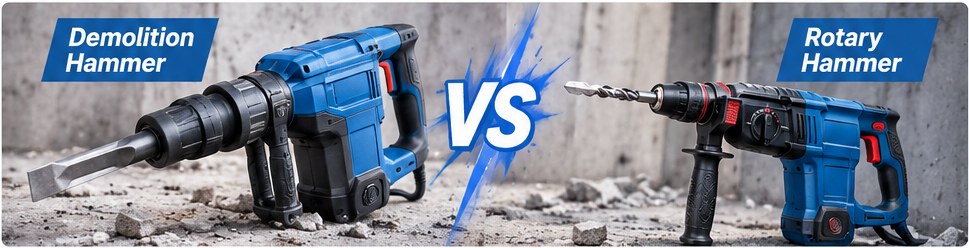
The key distinction: demolition hammers are made for impact and breaking; rotary hammers add a rotary drilling function.
A demolition hammer is a heavy-duty power tool designed primarily for chipping, chiseling, and breaking hard materials. Its motor drives a striking mechanism that delivers repeated impact through a chisel or point. Unlike a rotary hammer, a standard demolition hammer does not rotate the bit to drill a hole.
Because it concentrates on impact force, this tool is commonly used for jobs where material needs to be removed rather than drilled. Typical tasks include breaking concrete slabs, removing floor tiles, opening channels in masonry, and carrying out renovation or demolition work.
Demolition hammers are available in different sizes and impact capacities. Smaller models can be easier to handle for lighter chipping, while larger models are intended for demanding floor and concrete-breaking work. The right choice depends on the material, working position, job duration, and required removal rate. For lighter chipping on upper floors or in confined spaces, a cordless demolition hammer is easier to move and does not need a mains supply.
A rotary hammer is a versatile tool that combines rotary motion with a hammering action. This combination allows it to drill holes in hard materials such as concrete, brick, and stone more effectively than a conventional electric drill. Many models also include a hammer-only mode for light chiseling or removing small sections of material.
Rotary hammers are often used for installing anchors, drilling holes for pipes and cables, fastening fixtures to concrete, and completing general construction or renovation work. Depending on the model and chuck system, they can accept different drill bits and chisels.
Common configurations include SDS-Plus models for general construction and lighter drilling, and SDS-Max models for larger bits and more demanding applications. Always check the tool's rated capacity and compatible accessories before selecting a model. Where there is no site power, a cordless rotary hammer covers the same SDS drilling work.
The most important difference is the way each tool works. A demolition hammer delivers impact for breaking and chiseling. A rotary hammer adds rotation, making it suitable for drilling as well as certain chiseling jobs.
| Feature | Demolition Hammer | Rotary Hammer |
|---|---|---|
| Main function | Breaking, chipping, and chiseling | Drilling with hammer action; also chiseling on suitable models |
| Working action | Impact only; no normal rotary drilling | Rotation plus hammering; some models offer hammer-only mode |
| Typical materials | Concrete, masonry, tile, and similar materials | Concrete, brick, stone, and masonry |
| Typical tasks | Breaking slabs, removing tiles, and heavy chiseling | Drilling anchor holes, installation work, and light chiseling |
| Tool design | Often larger and focused on impact performance | Available in compact and heavy-duty formats for more varied tasks |
| Bit/accessory use | Primarily chisels and points | Drill bits and chisels, depending on chuck and operating mode |
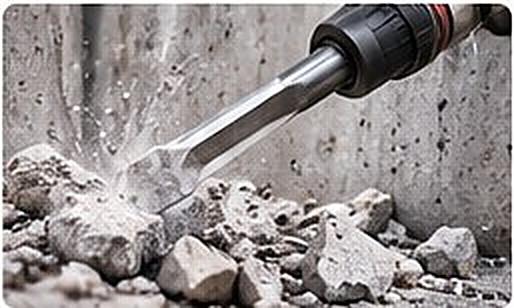
A demolition hammer is usually the better option when the main task is to remove or break hard material. Consider it for:
For these jobs, choose a model with suitable impact energy and a compatible chisel system. Also consider the tool's weight and vibration level: a more powerful tool may improve removal performance, but it can be harder to control during long periods of use or overhead work. If the task is cutting rather than breaking — trimming a slab edge or opening a doorway, for example — an electric cut-off saw is the more suitable tool.
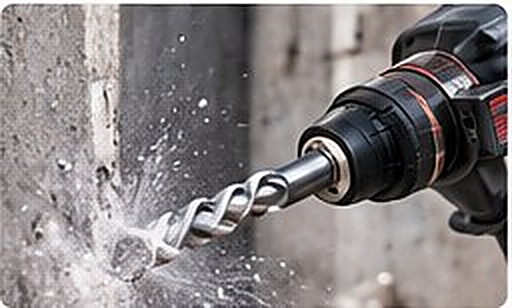
A rotary hammer is a practical choice when drilling is a regular part of the job and occasional chiseling is also required. Common applications include:
For buyers supplying contractors, installers, and general construction users, rotary hammers can cover a broad range of everyday applications. Match the chuck type, drilling capacity, impact energy, and available operating modes to the needs of the intended users. For lighter drilling into brick, timber, or metal, an electric impact drill is usually enough and costs less than an SDS machine.
It depends on the scale of the work. A rotary hammer with a hammer-only mode can handle light chiseling, tile removal, and small masonry adjustments. It may be sufficient for occasional, limited removal tasks.
For breaking thick concrete, removing large floor sections, or carrying out continuous heavy chiseling, a dedicated demolition hammer is generally more suitable. It is designed around impact work rather than balancing drilling and chiseling functions. Using the right tool can improve productivity and reduce unnecessary wear. Once material is broken out, surface levelling and edge finishing are normally done with an electric angle grinder.
Before choosing a hammer, consider the work that will be done most often. The following points can help distributors, contractors, and tool buyers compare models:
A demolition hammer is designed mainly for impact-based breaking and chiseling. A rotary hammer combines rotation and hammering, allowing it to drill into concrete and perform chiseling on models with a hammer-only mode.
A standard demolition hammer is not designed for rotary drilling. If you need to drill holes in concrete, use a rotary hammer with a suitable drill bit.
Both tools may be used, depending on the scale of the job and the model. A demolition hammer is generally better for larger or tougher removal jobs, while a rotary hammer with hammer-only mode can work for smaller areas. Use an appropriate wide chisel and take care not to damage the substrate.
No. A rotary hammer typically uses an electro-pneumatic hammering mechanism and is intended for harder materials and more demanding drilling. A conventional hammer drill generally uses a different mechanical impact system and is more suitable for lighter-duty drilling.
Compare application range, rated drilling capacity, impact energy, chuck system, motor specifications, ergonomics, durability, certifications, and the supplier's OEM/ODM and after-sales capabilities. Our guide to choosing a power tool supplier in China covers the qualification points in more detail.
MrPowertools provides a range of power tools for distributors, wholesalers, and professional tool brands. Explore our electric rotary hammer range and electric demolition hammer range, or contact our team to discuss product specifications and OEM/ODM requirements.
Note: Product capabilities and accessory compatibility vary by model. Always refer to the manufacturer's specifications and operating instructions.
Hebei Sinotools Industrial Co., LTD.
Copyright © Sinotools Industrial All rights reserved. Technical Support:REANOD

 EN